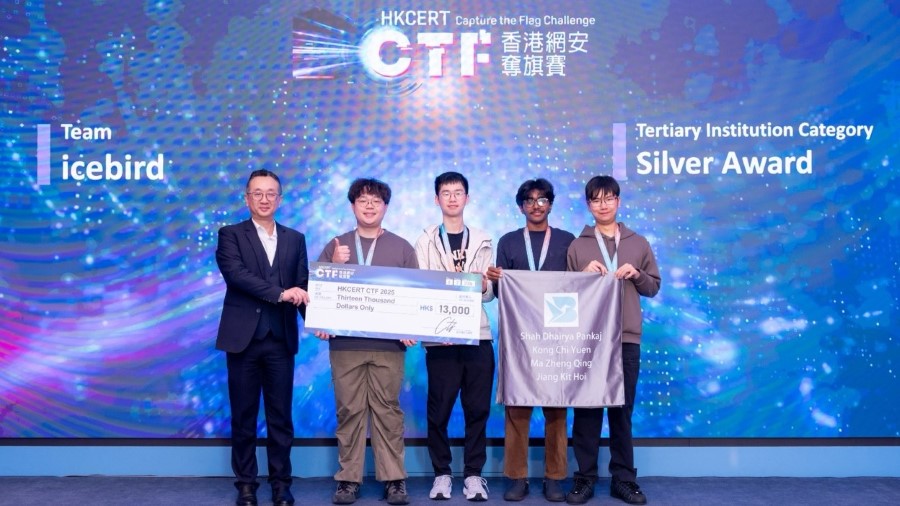


Team icebird at the HKCERT final
The HKCERT CTF 2025 final was one of the most memorable on-site competitions I have joined. Competing as icebird with teammates Jiang Kit Hoi Ivan, Shah Dhairya Pankaj, and Ma Zheng Qing Isaac, we finished with a Silver Award, which was also recognized as 1st Runner Up in the tertiary institution category.
What made this final different
Reaching the HKCERT CTF 2025 final was already exciting, but the biggest takeaway for me was experiencing AWD mode under real competition pressure. Unlike a standard jeopardy-style CTF where the focus is mainly on solving isolated challenges, AWD forces you to think about attack, defence, and service stability at the same time.
What AWD mode felt like in practice
In AWD, keeping your own services alive matters just as much as exploiting other teams. That means every minute counts: identify the weakness, patch the vulnerable service quickly, make sure the fix does not break scoring functionality, and then look outward again for offensive opportunities.
- Defend your own boxes before they start leaking points
- Patch carefully so the service still works after the fix
- Watch the scoreboard and react fast when attacks shift
- Attack other teams only when your own environment is stable enough
What I learned from the final
The final taught me that AWD is not just about technical tricks. It is also about discipline, communication, and prioritization. Good defence needs clean observation, fast validation, and calm decision making. Good offence needs timing. The best part of the experience was seeing how quickly small technical decisions could affect the whole match, especially when the whole team had to coordinate around the same service and scoreboard pressure.
Looking back
It was great to see HKUST CSE share the result as well, because the competition reflected real teamwork and steady preparation, not just a single good round. HKCERT CTF 2025 gave me a much clearer picture of how attack-defence competitions reward practical security thinking, communication, and adaptation in real time.